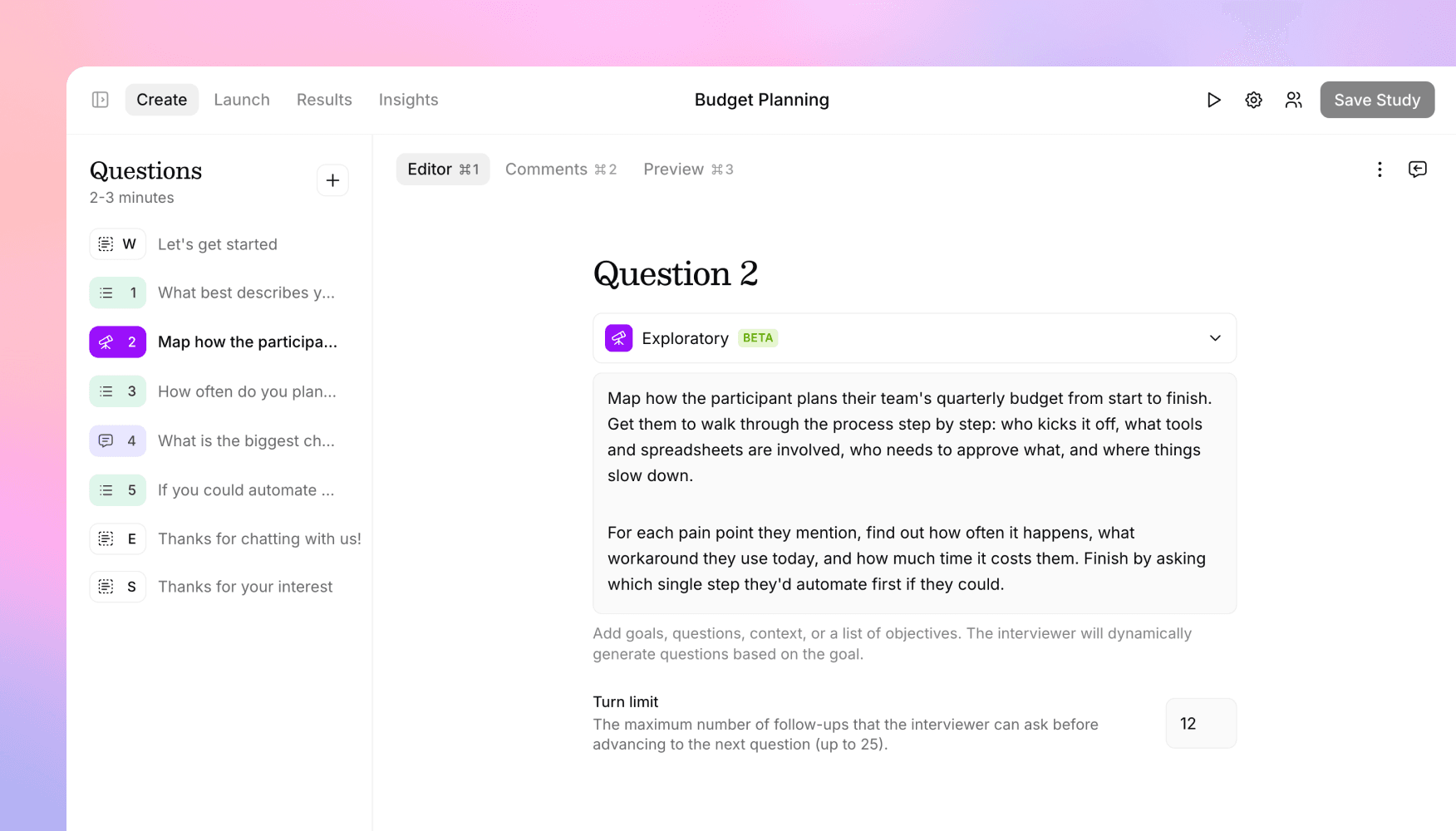
Introducing Exploratory questions: give the AI a goal, not a script
A new question type where the AI moderator runs a multi-turn conversation in pursuit of your goal, deciding what to ask next and tracking its own progress.
Versive's AI questions are great at going one level deeper: a participant answers, and the AI asks a smart follow-up. But some research doesn't fit a question-and-follow-up shape. You have a goal, like understanding how someone plans their team's budget, learning why they churned, or mapping their workflow, and you need a conversation that keeps going until that goal is met.
That's what Exploratory questions do. They're available now in beta.
How it works
Instead of writing a single question, you describe what you want out of the conversation:
- A goal or script: what you want to learn, in your own words. It can be as open as "understand how they decided to switch tools" or as structured as a step-by-step script.
- A turn budget: how long the conversation is allowed to run.
From there, the AI moderator takes over. It opens the topic, probes, follows threads, and decides what to ask next based on where the conversation has been. It tracks its own progress toward your goal and moves on when the goal is met, or when the turn budget runs out, so a chatty conversation never derails the rest of your study.
Built for multi-part questions
Exploratory questions shine on questions that are really several questions in a trench coat. For example:
"Find the participant's top 3 favorite brands. For each one, ask why they like it and what they would change about it."
With standard questions, that's a rigid grid that assumes everyone has exactly three brands and the same things to say about each. With an Exploratory question, the AI moderator handles it the way a human would: it gets the list first, then works through each brand naturally, adapting to how much the participant has to say and keeping track of what's been covered.
Works in text and voice
Exploratory questions run in both text and voice interviews. In a voice conversation, the AI pursues your goal with the same natural back-and-forth. Participants just talk, and the moderator steers.
You can also attach the same AI logic rules you use elsewhere: smart conditions evaluate the full conversation when it ends, so you can branch the rest of the study based on what was learned.
When to use it
Reach for an Exploratory question when:
- The territory is unmapped: early discovery where you don't know enough to write specific questions yet
- You need the full story: workflows, decision processes, or journeys that take several exchanges to unpack
- The question has multiple parts: enumerate-then-dig-in questions like the brands example above, where the follow-ups depend on earlier answers
- Depth matters more than consistency: you'd rather the AI adapt to each participant than ask everyone the same thing
For quick reactions and structured comparisons, your existing question types are still the right tool. Exploratory questions are for the conversations you'd otherwise need a live moderator for.
Exploratory questions are in beta. You'll find them in the add-question menu, and we'd love to hear how they work for you.
Get in touch
We're continuing to build features that help you learn faster. If you have any questions or feature requests, reach out to us at [email protected]. Want to give it a try? Start a free trial and start running research in minutes.

Eric Li, Co-Founder, Versive